Get Paid To Promote, Get Paid To Popup, Get Paid Display Banner -->
Showing posts with label Sloter. Show all posts

Monday, September 21, 2009

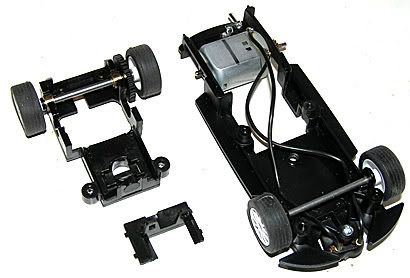
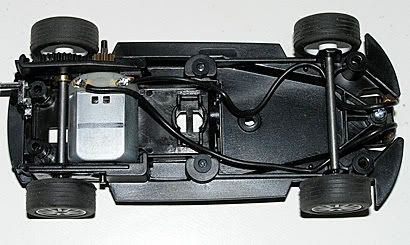
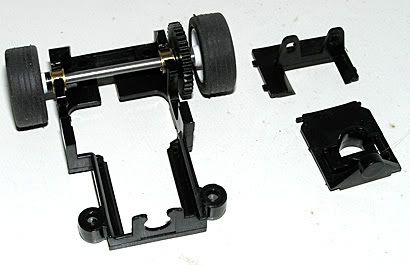
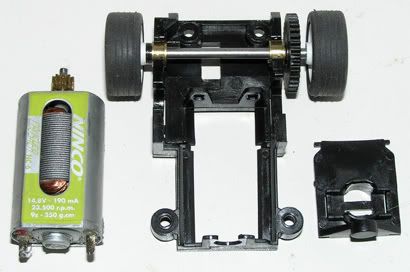
Sloter Zytek tuning by Daren Morris

Well it has taken a while to write this article and I know the subject was covered in the forum by Rolltidevet, but seeing as I built this car to race in the Manufacturers challenge that was run at 132Slotcar Raceway, I'd share the set up and results of what I have done.
This is a great looking car and I had high hopes for it when first looked at it. I started off running the car almost in the same state as I had received it, but seeing as we were running non mag I decided it would be pointless to start testing with the magnet in place. So remove a few screws whip the magnet out, screws back on and off to the track we go!

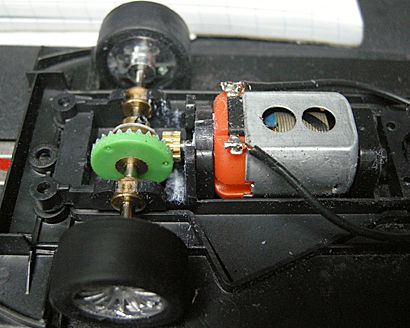
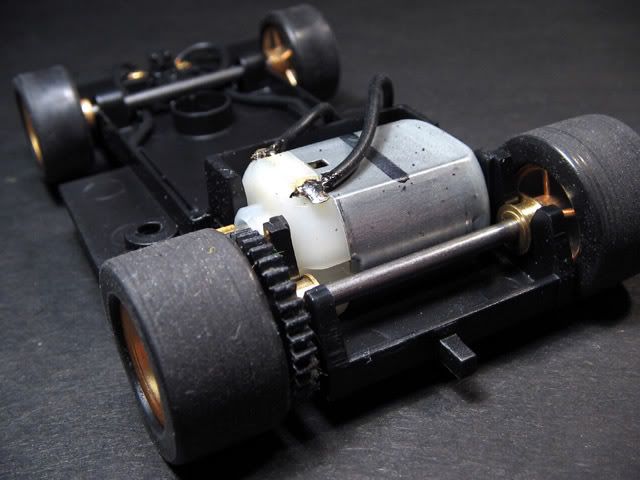
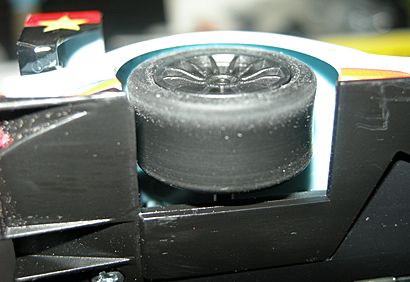
Well I ran 50 laps and the best I could do was 7.685 which is disappointing on my 70ft Scalextric Sport track. So off to the work bench and a first thing was to sand the rear tyres as they were rather concave as you can see from the picture even with light sanding the tyres were rather concave.
Back to the track for another 50 laps and best lap of 7.571 which was an improvement but nothing spectacular. Now it was time to try something else, so I backed the body screws out one turn each and headed back to the track for another 50 laps, the car was a lot easier to drive and much easier to get into a rhythm and achieved a 7.482.
Next on the list was to loosen the rear motorpod screws ½ a turn each, this helped some but the fit was really tight and I would need to do some “light” sanding to get the motorpod to move freely, first back to the track for another 50 laps and a best time of 7.426 not much improvement.

Started playing with the motorpod screws but could not improve on my 7.426 time at this point I decided to sand the tyres more making sure I had a nice even contact patch! This made a huge difference as I chopped my lap time down to 7.191 almost ½ a second improvement with all the stock parts.

Now it was time to start with the “tuner” parts. Seeing as the rules dictated Slot.It S2 tyres I decided to try those first which gave an improvement but the tyres were cupped and did not give the best contact. Although after 50 laps I managed a 7.093 lap now well over ½ a second faster!

With all this fiddling around I decided it was time to go the whole hog and see what we could get within the rules of the Manufacturers Challenge. First off I installed the Slot.It orange end bell motor, sanded the motorpod and the chassis to make sure it all worked smoothly. I wanted to use SCX Prorace parts where possible as Sloter is now supported by SCX. Unfortunately SCX does not have bearings to fit into the Sloter Chassis so it was back to Slot.It for those.I used the SCX Pro rear axle,green crown gear( 27 tooth if I counted correctly) and 10 tooth pinion, I used the SCX Pro wheels and siliconed the S2's to the rim, sanded the front tyres down to make sure the were round and even, installed the 7mm deep guide (provided with the car) and SCX Pro race braid.Off to the track again for the final shakedown and what a difference!! 6.399 for a fastest lap and what an awesome car to drive. To put the laptime into perspective my stock Slot.It F40 with S2's was only running a best laptime of 6.608. Obviously the best upgrade is the motor and tyres. I love driving this car the way it is right now, very predictable, fast and forgiving. It also finished first in the inaugural Manufacturers Challenge but I expect the competition to be a lot tougher in the next round.

I would like to thank Dave Kennedy for his support in the preparation of this article.


Article and photos by Daren Morris.

Wednesday, March 18, 2009

Sloter Opel Corsa 1600

A review by PeteN95:

The entry level rally car in Europe is the S1600 class which consists of small, FWD hatchbacks made by most manufacturers and seen commonly on roads all over Europe. This is the stepping stone rally class to the faster S2000 class and eventually the mighty AWD turbo cars of the WRC, the World Rally Championship. The smaller cars of the S1600 rally class are already well covered by other slot car manufacturers, with the Citroën Saxo, Fiat Punto, Ford Festiva, VW Polo, and SEAT Ibiza all available. Sloter enters the class with the Opel Corsa 1600.

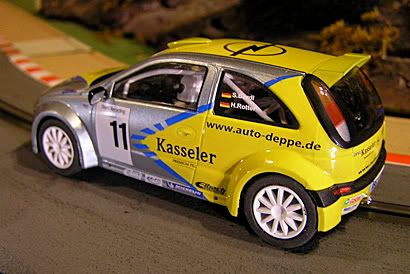
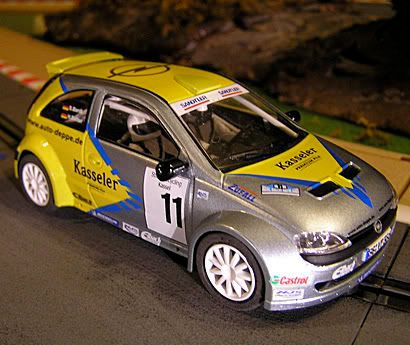
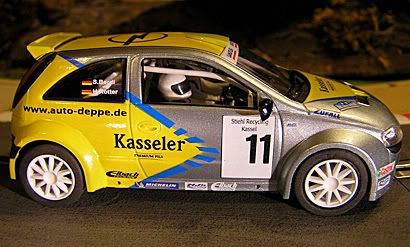
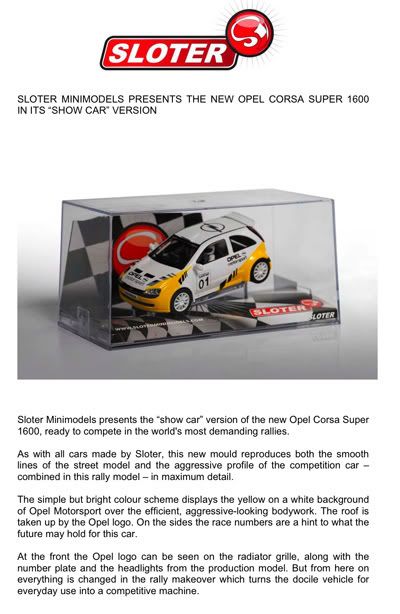
The Sloter Opel Corsa is an aggressive looking, but small car with a spoiler at the rear and an air scoop at the front of the roof panel. It is covered in a factory rally livery of silver, blue, and yellow with a large Opel logo on the roof. The paint and striping quality is pretty good, but the yellow on the scoop and spoiler is a little thin and there are places where the stripes are not as crisp as they could be. There is a fairly well detailed, full depth interior with a full roll cage and driver and navigator figures. The Corsa is also available in a “roll out” livery, as well as a plain white version if you’d like to do your own livery.

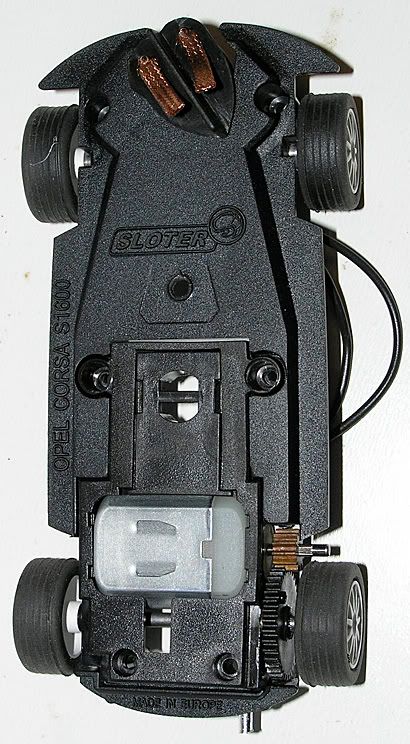
The reason the Opel has a full depth interior is it’s a sidewinder (SW) drive train, which I believe is a first in it’s class and unusual in slot rally cars in general. It also has a very unique and innovative motor pod design. The pod looks a bit like a Slot it type at first because it has four screws near the corners, but it is not designed to float. Instead, it is made to be modular, allowing different types of motors to be mounted in different orientations using the same pod! They do this by using some very clever inserts which simply snap into the main pod. The inserts are then locked in place when the pod slides into the chassis. The pod actually slides up into the chassis about ¼” into a very tight fitting cavity, eliminating any possible movement or flex required to remove the inserts.


The motor is a standard Mabuchi (18k) similar to other RTRs mounted in a bell drive SW configuration, but the pod also allows a long can boxer style motor to be mounted in an inline configuration. This is done by removing the front insert in the pod, after removing the pod assembly from the chassis. The rear pod screws also function as the rear body mount screws, so after removing the body with two screws in front and the two rear pod screws, all that is required to remove the pod from the chassis is to remove the front two pod screws. The pod then slides down out of the chassis and the front insert, which contains a thick Fly/Ninco sized button magnet, can be snapped out. After the motor is removed, the extra pod insert that comes with the car can be snapped in place of the SW motor and you have converted the pod to a long can inline set up. Of coarse you will have to change out the SW spur gear for an inline crown gear (not included), but a very clever design!


I ran the car straight out of the box, with the magnet, and it went very well. Not too stuck down, but very stable. It read about 180gms on the Magnet Marshall total, with a weight of about 79gms, so about 100 grams of additional down force. The car did have quite a bit of gear noise from what turned out to be a slightly tight gear mesh. It has quieted with additional running and I would prefer a little tight out of the box, as opposed to too loose to begin with. It was now time to remove the magnet, as I believe all rally cars should be set up, so I lubed the bushings while I had the body off. This is where I ran into problems. The tires are rather soft and although there was no problem running with the magnet, the tire spin when the magnet was removed caused the tires to expand and come off the wheels. I had a similar issue with the Sloter Opel, so I got some glue to fix the tires to the wheels.

Unfortunately, a bumbled and hurried attempt at using fast Superglue resulted in destroying the stock tires. Slower glue gives time to seat the tires correctly, for future reference! Normally this would not be a problem, but the Corsa uses a strange size tire, about 20mm x 8mm?! Even in my large collection of spares, I had nothing similar. Fortunately, the wheels were a standard size and some Ninco ribbed rally tires in 19x10 size fit just fine. A little Dremel work in the rear wheel wells was required to give clearance for the wider tires, but just a bit. The stock tires are pretty soft and I think they would work fine for non-mag running if glued to the rims, but be careful and use a slower adhesive, unlike myself.

With new tires installed, we were ready to do some real rally drifting! And drifting is what this Opel excels at! I was amazed as I got up to speed by the degree of control afforded by this very small car. The more I drove it, the more I liked it. Most of the smaller slot cars tend to be rather tricky to control at the limit because of the short wheelbase and narrow track, but the Corsa was very easy to drift in a nice controlled arc, all the way through most turns. The standard 18k Mabuchi motor is plenty powerful for this small car, but an NC-2 might also work well in the long can, inline configuration. I just can not imagine the car being any better balanced than it is now. Sloter still could work on making the wheels more concentric, as the car vibrates a bit, but overall this car is an improvement over their first rally car, the Opel Manta, and probably the fastest S1600 class slot rally car available at this time.

Wednesday, January 14, 2009

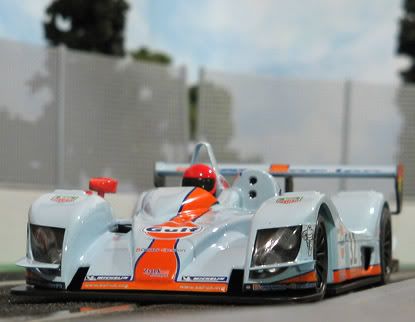
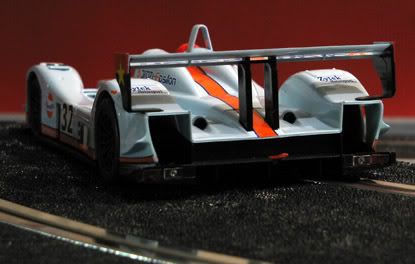
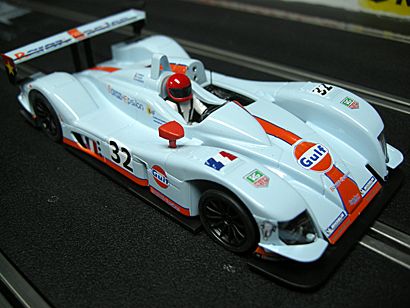
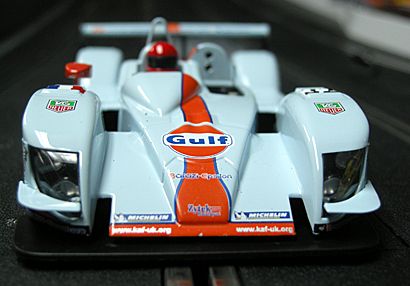
New Sloter Gulf Zytek


Sloter has introduced the new mold of Zytek, and the first livery is a Gulf deco! See a gallery of photos at this link, I've also shot a few photos with the previous mold and this new one to show the differences.

Monday, January 12, 2009

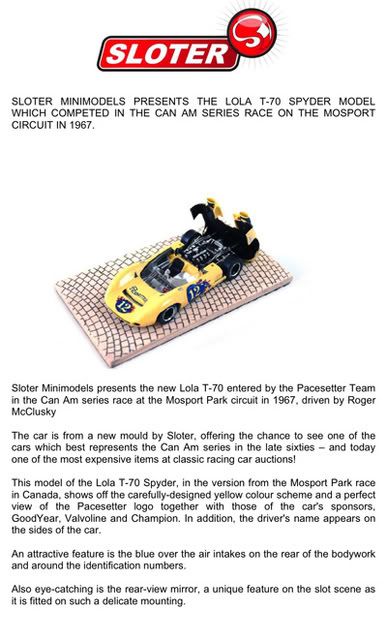
Sloter Lola T70 Spyder Mosport 1967

Sports car constructor Lola has been in the business of building race cars for fifty years now. One of their most iconic designs is the T70. It’s origins lie with the Lola Mk VI which was a mid-engined Ford powered fastback. This car competed at LeMans in 1963 and while it suffered with gearbox issues, it was able to record the second-fastest lap of the race with only three gears working. This got the attention of Henry Ford, who had recently had his merger talks spurned by Ferrari and who was ready to seek revenge on the race track. He contracted Eric Broadley, the founder of Lola, to work for the next 18 months on a Ford powered collaboration which resulted in the GT40. The rest is history: the Mk VI derived GT40 won LeMans in 1966, ’68, and ’69. This contract funded the stabilization of Lola cars and 1965 they introduced the T70.

The car was quick out of the box with the T70 besting the lap record at Silverstone by 7s. The car was a coupe design with a semi-monocoque chassis and Chevrolet power. By 1966 the T70 was revised to a Spyder configuration as the T70 Mk II. Since the motor was not a stressed member of the chassis privateers had some flexibility in terms of powerplant selection. Some would fit Ford motors in place of the standard Traco built Chevy unit. This car quickly racked up victories in the USRRC and CanAm series including wins by John Surtees and Mark Donohue. Even though Surtees scored the inaugural 1966 CanAm championship driving a T70 Mk II Lola cars would see only three other CanAm victories as McLaren and Porsche took turns dominating the series.

The car as depicted by SCX competed in the third CanAm race of the 1967 season at Mosport. This car was driven to fifth by Roger McCluskey behind the fourth place T70 of Peter Revson and a trio of McLarens on the podium. These awesome CanAm machines were clocked at over 180 mph on Mosport’s long uphill back straight.

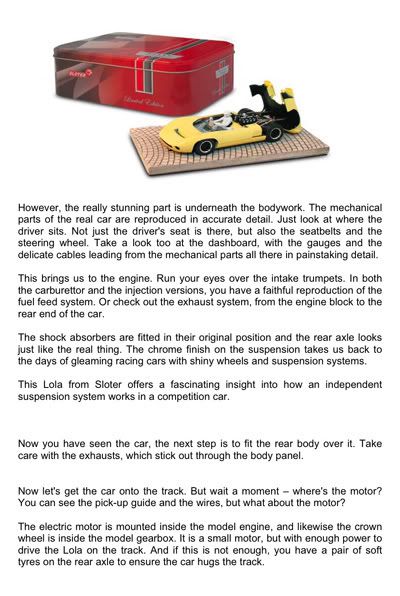
Sloter’s T70 is beautifully presented in it’s cookie-tin case. The rear deck is fixed in the open position revealing a fully detailed engine compartment. The cockpit is also chock full of detail: instruments, switchgear, and shift linkage. While the Sloter Lola arrives without a driver, a bagged figure is provided should you want to put one behind the wheel. High detail level aside, what Sloter has managed to accomplish with this model is to package an HO motor inside the model’s motor in the engine bay turning what would otherwise be a stunning static model into a slot car.

On track the performance of this car is mild. Even though the tires are slightly cupped the car handles smoothly. There isn’t enough torque in the HO motor to push a traction magnet around the track in this car so none is provided. Initial testing at Mini Grid’s Maxport II circuit yielded an 11.2s lap time. After circulating for a while I noticed that the car started slowing down with the lap times gradually increasing. The motor felt warm to the touch. After allowing the car to cool off I lubricated the rear bushings, adjusted the braids, and ran a few more laps. I was able to get my lap time down to 10.2s. This puts it in the zone with the NINCO Ferrari 250TR (10.1s), Pink Kar Ferrari 250 GTO (10.2s), Monogram Porsche 550 Spyder (10.3s), and Scalextric Ford GT40 (10.3s).

I really like Sloter’s T70 Mk II. While it is a mild performer, it’s a blast to race against similarly powered cars. The detail on this car is second to none and is really what one is paying for here. Truing the car’s tires on a Hudy or similar tire grinder (off the car), and making sure the drivetrain is properly lubricated will help purchasers get the most out of their car. I’d love to see Sloter make a less detailed version of this model using an S or FF can motor for power. This would allow their stunning T70 race against Fly Classics. If you like lower powered non-magnet cars then this is certainly one to consider.

Sunday, October 26, 2008

New Sloter Zytek prototype pix


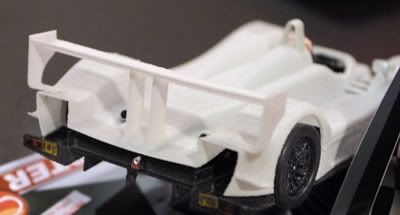
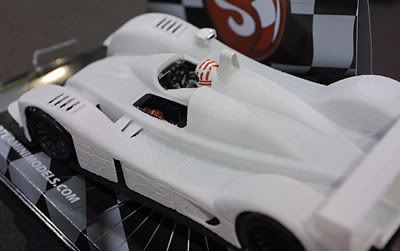
Sloter has a new Zytek on the way. I shot these pix recently at iHobby of the new body they're going to produce. Please note this is a white body and I had to darken it substantially for the contours to show here.

Wednesday, September 10, 2008

Tuning the Sloter Opel Manta

The Sloter Opel Manta has gotten some negative comments concerning its less than perfect representation of the 1:1 car, the unorthodox layout, and the somewhat weak and overly flexible chassis. These complaints are not without substance, but simply dismissing the Sloter Opel as not worth buying is much too harsh. When I looked at the car, I saw an innovative model design of a “not done before in 1/32” Group B rally car. Although not AWD like most Group Bs, the Manta was very competitive on the paved rallies. And since I collect Group B cars, which are the “Can Am” of rally cars, I thought I would take a closer look. The first thing I noticed was the lack of a traction magnet, which I believe is only correct for rally cars, as they are meant to slide and drift.
The unusual aspect of the cars layout is the wide angle, anglewinder (AW) SCX Pro Speed motor set up. The Pro Speed is one of the most powerful SCX motors (20k rpm), but it is still controllable when running with no magnet. I actually prefer SCX motors for rallying because they have a smooth powerband without too much torque and still have a good top end rev, which is good for rally because it is easy to drive. This also makes for a fun car to just race with a friend. The AW layout moves the center of gravity (CG) back slightly compared to an inline, improving rear grip, but also gives more room for the drop arm guide within the stock wheelbase.


The AW uses what appears to be a standard inline crown gear and pinion. Because this gives a smaller contact between the gears, the gear mesh is critical to avoid damage. Mine was a bit on the loose side, so some adjustment was in order. By carefully squeezing the rear axle just beside the crown with a pair of needle nose pliers, then twisting the pliers slightly, you can move the pressed on gear slightly on the axle adjusting the mesh. Do this in small steps to avoid making the mesh too tight. Mine runs very smooth and quiet after setting the mesh to minimum free play. Since the gear seems to be just a standard inline crown, aftermarket inline crown gears should also work. The mesh would also be much easier to adjust with a set screw type gear.

The drop arm style guide may be new to some people who aren’t familiar with rally cars or vintage slot cars, which also sometimes use this style. The drop arm allows the car to traverse bumps and uneven surfaces, as found on rally tracks, while keeping the guide in the slot. If properly adjusted, this style of guide should have no negative affects on the cars operation. There is a screw mounted on the chassis just above the guide which limits the upward travel of the arm. This should be adjusted so that the guide is fully engaged in the slot when the car is sitting on the track. Use either a set up plate or an extra piece of track to check this adjustment.

The drop arm mechanism includes a small spring which ensures the arm will drop and follow the surface of the track. This spring should be very light and not put excess force on the guide, which might cause the front of the car to lift off the track. I found the spring was a bit too strong and made a slight adjustment by bending the spring a little flatter than it was originally. I also managed to break the chassis were the arm attaches, but made a fix by gluing on an old axle bushing. I have been told that Sloter is aware of the weak chassis and is sending free improved replacement chassis’ to customers on request. I have made a request and will report back when it arrives. This is some very impressive customer service.After adjusting the drop arm, I noticed some slight interference between the guide and the body when the guide was all the way up. The guide was moving through it’s full travel, but it was contacting the body behind the grill which made for some inconsistent drifting action, which is critical for a rally car. It was an easy fix to take the Dremel and make an arc shaped relief on the back side of the lower part of the front valence and grill. The relief did cut through part of the grill, but because the grill is all black plastic, the hole is not visible when the car is assembled.


I also did some standard tuning tricks, such as truing the wheels and tires on some sand paper. I added some lead on either side of the motor because the car had good grip (with stock tires!), but tended to roll at the limit. I installed some low profile front tires to eliminate some interference with the front fenders. With these changes, the Manta went from an erratic mid pack car to one of the quickest 2WD rally cars I have. I hope the new chassis makes the car even better and will report back when I am able to try it. So although it is far from perfect out of the box, with some relatively simple tuning, the Manta joins Sloters other cars as some of the quickest non magnet slot cars available.

Sunday, December 9, 2007

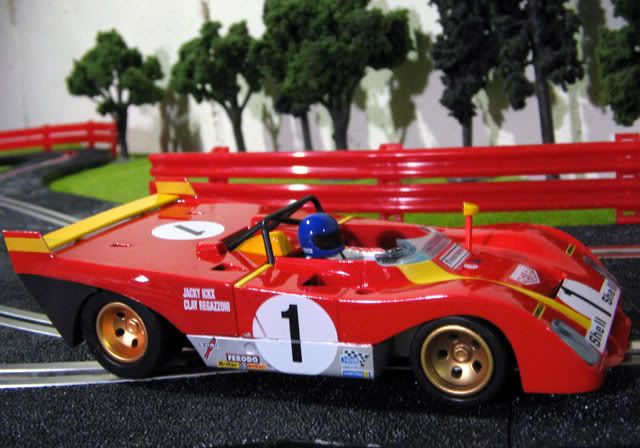
Sloter Ferrari 312-#1 reviewed

Straight forward and exciting. Sloter's cars have given enthusiasts one cool little car after another, adding to that list is the latest 312 Ferrari.

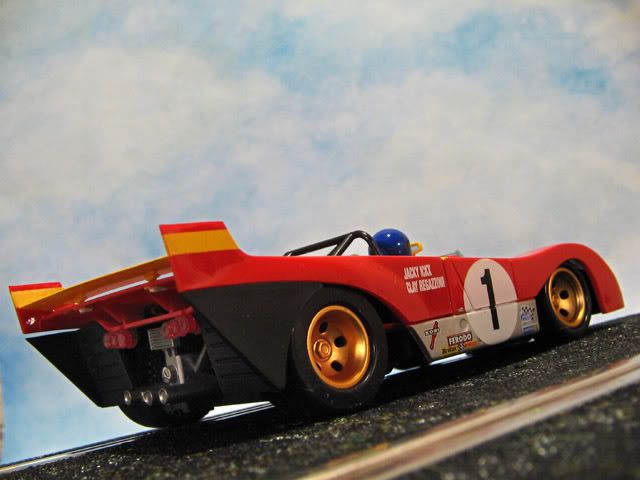
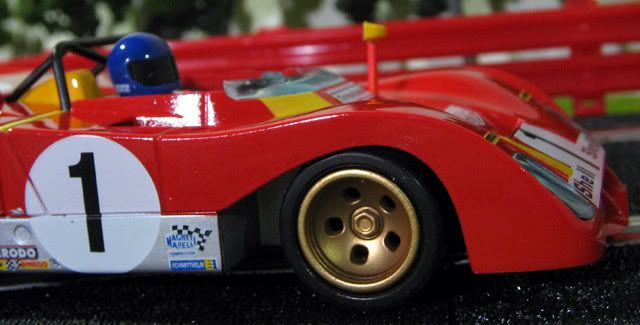
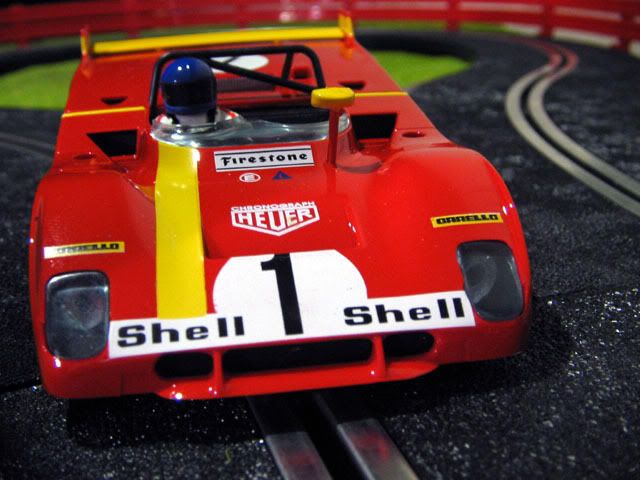
The finish on the car immediately grabs your attention. Bright red with bright yellow striping. All perfectly done, no fading, no runs. There have been many liveries done by Sloter of this car but this may be the best...heck it's "No. 1" after all!

A walk around to the back of the car and we see a well detailed representation of the tail pipes and a very thin horizontal yellow tail wing.

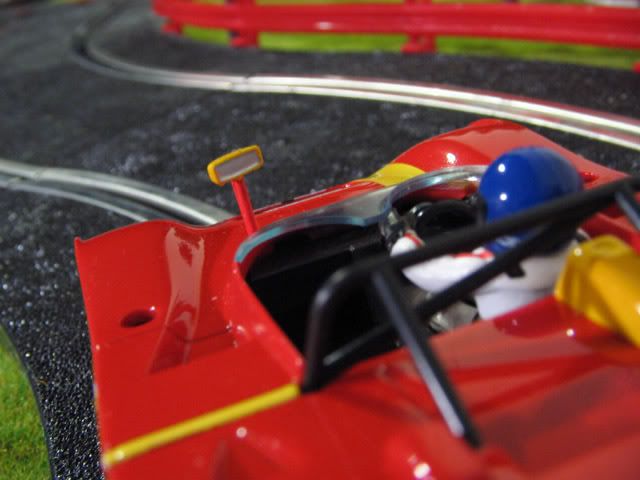
The interior of the car lacks fine detail but gives you a good sense of the cockpit without going overboard with difficult to see (and expensive to reproduce BTW) dash details. The Jacky Ickx driver is less stiff looking than some drivers, which is a subtle detail I'll grant you but it does add to the overall feel of the car. The windscreen on the car is the usual clear/greenish plastic and is nicely done.

Deep dish gold wheels hold those surprisingly sticky Sloter tires.

Under the car we see the standard Sloter chassis with it's podless design. Gear mesh is smooth and spins easily when you give it the in you hand "thumb spin". As an aside, this is probably the first thing most slot racers do when they pull the car off the plinth and hold their new slot car for the time. There's nothing like a nice, smooth spin of the back axle is there? A lot can be gotten from this simple "test" of a slot car.
Does the axle spin easily? In this case, yes it does. Do those gears mesh smoothly? Yes, again. Is there sideplay in the axle... well yes, a bit. So there might be a spacer in this slot cars future, just to make sure there's not too much gear noise going around the turns. And in this case the axles are .098"...I just thought I'd throw that in there for reference.

A spin of the front axle and you can tell a lot as well. The axle spins well. The front tires do wobble a bit as do the wheels. There is a fair amount of sideplay on the front axle as well. But not much up and down float, I like this, it tends to make a car more stable in the turns. It would be nice if the car had less sideplay in both front and rear axles.

On the track at East New York Raceway wood track the 63 gram car (which is 2.47" at its widest point...again, just for reference) had some issues making fast laps. We got times for this car in the 6 second range. Which by standards of many other non magnet cars isn't terribly fast. We trued the tires a bit and the car smoothed out a bit but still I feel it would benefit from at least 15 grams of lead.

Sloter cars have quite a following. If you have a Sloter collection I'm thinking that no amount of verbage I or anyone will write really means much to you...you want this car I'm thinking. If you don't have any Sloter cars the Ferrari's have a nice feel to them and they have a very appealing body, and in this case the finish is another reason to grab up the latest Sloter 312.

Dave Kennedy
Publisher, Slot Car News

Wednesday, July 4, 2007

SCX/Sloter collaboration

This is similar to Sloter's recent statement but I just got this from SCX so I thought I'd pass it along.

"SCX® and Sloter have signed an agreement under the first stage of which Sloter will be supplying SCX® the digital system technology in its new models. The first Digital car from Sloter will be the renowned Lola T280 of 1972, featuring the logo of the Banco Intercontinental Português.

In its second stage, this alliance will enable SCX® and Sloter to develop an extensive joint catalogue of cars which will include the models most eagerly awaited by slot racing enthusiasts.

Adapting Sloter cars to SCX® digital technology means developing a new chassis featuring the electronic chip and the mechanisms needed to make the lane changes that characterise the system. This will make new models available to slot racing enthusiasts for overtaking and “boxing in” their opponents at top speed.

The firm Sloter Minimodels was set up in 2005 by slot racing enthusiasts and trade professionals. As enthusiasts they began their career in the 60's by competing in and organising rallies and endurance races. They were also in charge of organising the national SCX® championships in Spain from 1986 to 1992. Professionally, the members of Sloter Minimodels boast experience built up in senior positions in the top slot racing firms.

In 2003, SCX® revolutionised the market with the launch of SCX® the digital system. This technology features an electronic chip which enables drivers to change lanes, with up to six cars competing at once on a single track and customising each car's driving style by setting the braking power and the amount of fuel available, with constant monitoring of information about the car. With SCX® the digital system strategy counts for as much as driving skill in getting to the top spot on the winner's podium."

Saturday, June 30, 2007

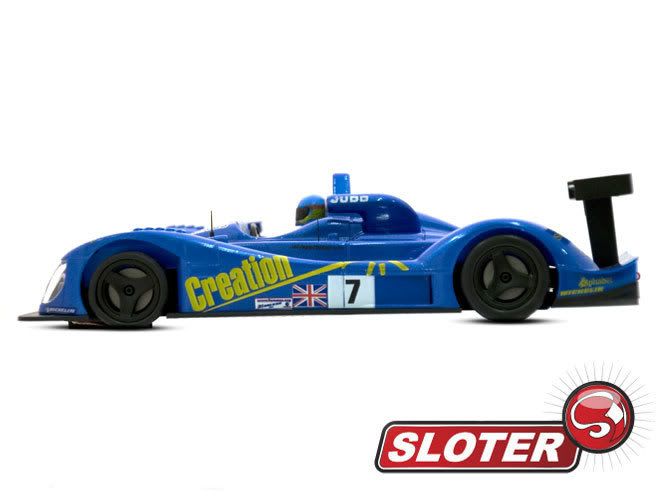
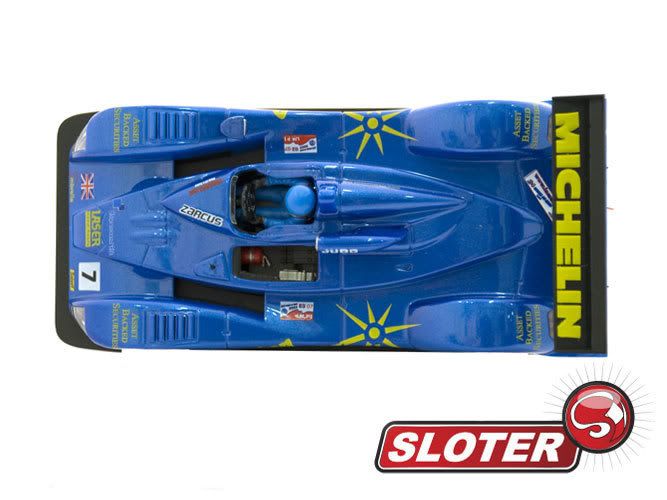
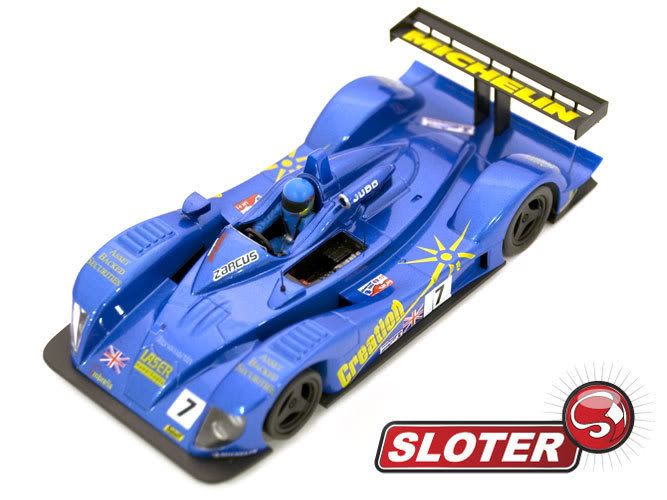
Blue Sloter Zytek photos


Thanks to Sloter for use of the photos.
DK