Get Paid To Promote, Get Paid To Popup, Get Paid Display Banner -->
Showing posts with label Volkswagen Jetta. Show all posts

Wednesday, June 15, 2011

Car Review - 2011 Volkswagen Jetta

2011_volkswagen_jetta_car_review
Car Review - 2011 Volkswagen Jetta: After years of trying to obtain compact sedan to dress the part, Volkswagen has finally managed to naturalize the Jetta. This German 4-door now wears a suit that is required to reach an agreement with the notoriously conservative American masses, and is priced car that buyers are much more attractive, thanks to a lot of things cost reduction. However, these changes occur at a price themselves.

Model Lineup: Volkswagen is offering the 2011 Jetta in four trim levels, from bare-bones to dressed-to-the-nines. Eventually a fifth model, the performance-oriented GLI, will join them on showroom floors. Things get started at S trim, featuring 15-inch wheels and not much else; cloth seats and soul-crushing hard plastic dominate the cabin. Fortunately, stepping up to SE trim takes care of a few of those issues. Stylish 16-inch rollers take the place of the smaller 15-inch wheels, and leatherette seating surfaces show up inside. The interior also receives a small dress-up package in the form of chrome accents around the climate-control knobs.

You can also adorn your Jetta SE with a convenience package that throws in amenities such as a leather-wrapped steering wheel and a more civilized 6-speaker sound system, though we would be just as likely to opt for the SEL trim. This next step up throws in all of the goodies found in the SE convenience package, but adds hardware such as a fog lights, 17-inch wheels, keyless entry and a navigation system.

At the top of the lineup is the TDI. It's basically a Jetta SE with disc brakes on all four corners and an uberefficient diesel engine.

Under the Hood: Volkswagen has added a new engine to the Jetta lineup for next year. Starting in 2011, you can get your sedan with a 2.0-liter 115-horsepower 4-cylinder engine that produces around 125 lb-ft of torque. The new engine is part of the company's plan to lower the price tag, and it comes bolted to either a 5-speed manual transmission or a 6-speed automatic. While the Environmental Protection Agency hasn't issued fuel-economy figures for the new engine yet, Volkswagen promises somewhere around 24 mpg city/34 mpg highway.

If the little 2.0-liter doesn't serve up quite enough punch for you, Volkswagen is also offering the same 2.5-liter 5-cylinder engine found in the previous generation. For next year, buyers will have the choice of the same two gearboxes offered with the 4-cylinder engine. Either way, they can expect the 2.5-liter to churn out a more respectable 170 horsepower and 177 lb-ft of torque, all while returning just 1 mpg worse on the highway.

The company's endearing 2.0-liter turbocharged 4-cylinder diesel engine will also make a return for 2011. It produces 140 horsepower and a ridiculous 236 lb-ft of torque, making it feel significantly larger than its diminutive displacement would suggest. Expect to see around 30 mpg city/42 mpg highway when equipped with either the 6-speed manual or 6-speed direct-shift gearbox.

As we mentioned above, the GLI will likely debut later in the year, featuring the Jetta engine that we've come to love, the 2.0 TFSI.

Inner Space: Volkswagen has proudly proclaimed that the 2011 Jetta was designed to be more in line with American tastes; the company stretched the sedan's wheelbase by 3 inches to add interior room front and rear. Full-grown adults can now comfortably camp out in the back seat without having to fold their shins or collapse a few vertebrae. That doesn't mean things are all sugar and spice in the cabin.

To begin with, the dash has lost the nice soft-touch material of the last generation, in favor of hard plastic in S trim. Why? Volkswagen is looking to do away with the dreaded "European car premium" that U.S. consumers have to pay for its cars. And the cost of this lower price tag is a less-than-savory interior. In this case, the cabin is borderline cheap. The new switches and knobs aren't what we've come to expect from Volkswagen, either. Flipping through the climate controls, we couldn't help but pine for the weighty clicks of the old hardware.

That said, plop your derrière in the leatherette-lined goodness of SEL trim and it's easy to forget about the cost-cutting measures. With the leather-wrapped steering wheel firmly in your palms and a comfy bucket seat beneath you, there's little to complain about inside. Throw in the extra legroom and it's easy to believe that some sacrifices may actually be worth the net savings.

On the Road: We were able to nab some time in the 2011 Jetta SEL, complete with the company's 2.5-liter 5-cylinder engine and a 6-speed automatic transmission. In this guise, it's difficult to find fault with the drivetrain. Of course, there shouldn't be one. Volkswagen has had years to perfect this particular concoction, and as a result, you're rewarded with a powertrain that's almost perfect — almost. The 170-horsepower engine provides just enough low-end grunt to dispatch with foes in the right lane without too much heavy breathing. At the same time, torque steer is nonexistent. Despite the uniquely torquey feel of the 5-cylinder, zero to 60 mph shuffles by in 8.6 seconds — not exactly rocket-quick.

Things have gone downhill somewhat on the handling front, though. In another effort to keep the cost down, Volkswagen opted for a torsion-beam rear suspension instead of an expensive, fully independent setup. Whereas the previous-generation car could be coaxed into being entertaining while carving through your favorite mountain passes, the 2011 model is more content to amble from point A to point B.

Volkswagen has also changed the hydraulic power steering system by 2010 - a move that generally produces more steering feel. Only instead of getting more feedback from the helm, we are rewarded with much less. It feels like electricity, and the truth is that the previous car felt a plumber. Of course, it is important to remember that Volkswagen does not build the fans of this Jetta. The company has designed the U.S. average car buyer - a group that is more concerned about the number of cup holders as the steering feel. -- car review --

Related posts:

Wednesday, January 12, 2011

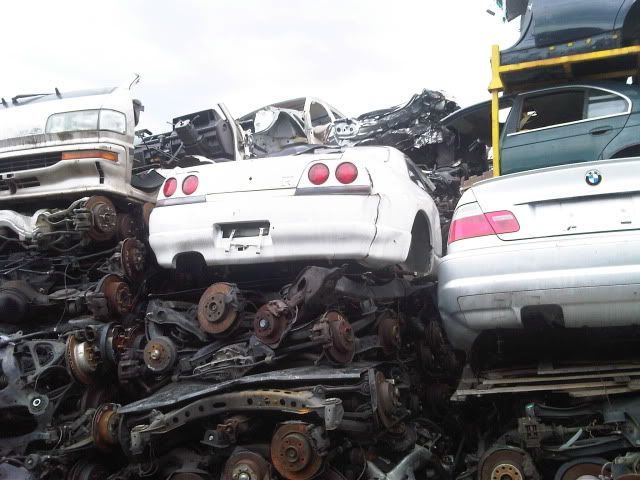
It's Amazing What You Can Find In Half Cut Yards These Days

A Nissan R33 Skyline GTR Rear Half Cut (I purchased this by the way)

A Fiat Turbo 20V Coupe Rear Half Cut

 A Volkswagen Jetta Rear Half Cut

 An Alfa Romeo 155 Rear Half Cut

A Peugeot 206 CC Cabriolet Rear Half Cut

A BMW E46 Coupe Rear Half Cut (not sure what model but it's rear bumper might have housed quad exhaust tips ala M3)

 The E46 Rear Half Cut Had Aragosta Suspension Rear Shocks!

It's Amazing What You Can Find In Half Cut Yards These Days

A Nissan R33 Skyline GTR Rear Half Cut (I purchased this by the way)

A Fiat Turbo 20V Coupe Rear Half Cut

 A Volkswagen Jetta Rear Half Cut

 An Alfa Romeo 155 Rear Half Cut

A Peugeot 206 CC Cabriolet Rear Half Cut

A BMW E46 Coupe Rear Half Cut (not sure what model but it's rear bumper might have housed quad exhaust tips ala M3)

 The E46 Rear Half Cut Had Aragosta Suspension Rear Shocks!

Tuesday, March 31, 2009

2009 VW Jetta TDI Road Test: Turbocharged Torque

Torque is described as a force that tends to turn things and, in the case of the 2009 Jetta TDI, its abundance turned me into a fan of this latest in a long line of Volkswagen "oil-burners" by providing strong performance and flexibility along with exceptionally high levels of fuel economy.

Torque is what you get when you, for example, tug on the handle of a wrench to tighten or loosen a nut. Doing so exerts a twisting force still expressed here, in Ye Olde English, in lb-ft, as nobody on this side of the Atlantic has any idea what a newton-metre is.

Torque in an engine is generated by burning a fuel/air mixture in a cylinder, with the pressure of the expanding gases pushing the piston, which is linked to the crankshaft by a connecting rod, downwards.

As this occurs, the angle generated by the crankshaft "throw" increases and the rod, like the wrench handle above, rotates the crank. And that, with a few things such as clutches and transmission gears in between, is what makes your car move.

The Jetta TDI, with its turbocharged diesel engine, does this with a degree of vigour, accompanied by a high degree of overall flexibility not normally experienced in the compact-car category. Most small-displacement gasoline engines don't produce a lot of torque, and what they do is generated at higher engine speeds.

The TDI's four-cylinder engine delivers a disproportionate (for its displacement) amount of low rpm "grunt" that lets it charge off the line like a V-6 but also maintains that strong pulling power at highway speeds.

This allows it to coast along at minimal revs in top gear while sipping fuel at such a frugal rate that 1,000 km per tank wouldn't be an unlikely achievement. In fact, the number on the trip computer that estimates how much distance I had before needing more gas disconcertingly went up for the first hundred kilometres or so that I drove the car.

The TDI's arrival last year marked the return of the popular diesel engine option to the VW lineup in North America — it hadn't been able to sell a diesel here in 2007 due to U.S. emission standards — and the Jetta range now offers three engine choices, each of which gives the car a different driving character.

There's a gasoline-fuelled, 2.5-litre, four-cylinder that makes 177 hp at 5,700 rpm and 177 lb-ft of torque peaking at 4,250 rpm. With six-speed automatic transmission, it delivers very good performance and fuel economy ratings of 10.5 L/100 km city and 7.2 highway.

Also available is a performance-oriented, gas-burning, turbocharged 2.0-litre unit rated at 200 hp at 5,100 rpm and 207 lb-ft of torque from 1,700-5,000 rpm. This makes the 2.0 TSI Jetta a very quick car indeed and, thanks to the turbo, produces plenty of torque over that wide rpm range, which helps it garner very good fuel economy ratings of 9.0 city and 6.8 highway.

The 2.0-litre, four-cylinder diesel engine in the TDI delivers the least power, 140 hp at 4,000 rpm, but the most torque, 236 lb-ft, all of which is available from 1,750 to 2,500 rpm. Its fuel economy ratings are 6.8 city and 4.9 highway. The on-board readout was showing an average of 7.1 L/100 km when I returned it.

The "oil burner" appellation used above is in reference to the bad old days of low-powered and stinky diesel engines. This new one makes 40 hp more than the previous 1.9-litre unit and burns ultra-low-sulphur diesel very efficiently and cleanly and is also quieter.

And the direct shift gearbox (DSG) is a treat, snapping off lightning-quick shifts automatically or allowing you to select gears yourself. Although it takes a while to get used to the fact that it only revs to about 4,500 rpm between the gears, acceleration is surprisingly strong.

And its direct steering, firm suspension and good brakes also contribute to making it a very enjoyable car to drive.

The Jetta TDI is available in base manual transmission Trendline form at $24,275, in Comfortline trim at $26,775 and Highline versions go for $29,775. Our DSG-transmission-equipped tester had a sticker price of $31,175 and an all-in-but-the-taxes cost of $33,510. By comparison, a base gasoline Jetta 2.5 goes for $21,975 and a base 2.0 TSI for $27,475.

The base TDI comes with the usual features at this price, plus cruise control, climate control, 16-inch wheels, exterior temp gauge, a single CD audio system and front, side and side-curtain airbag systems.

The Comfortline has some extra chrome trim, a power-reclining driver's seat, heated seats, leather-wrapped wheel and a premium six-disc audio system. The Highline adds a compass, leather upholstery, a multi-function wheel, a sunroof and a rear armrest/pass-through.
In typical VW fashion, the interior is designed to meet more utilitarian than utopian standards for style. There's rather-uninspired plastic aplenty, not only where you can see it but also feel it — the surprisingly nasty and hard-edged door pull, for example.

The somewhat stark look and feel is ameliorated by stitched padding on the armrests, rather-nice mesh-finish aluminum trim and thin aluminum bezels around the gauges that perk up the plainness a bit.

The cabin is quiet enough at highway speeds, the leather-clad front seats are supportive and comfortable, the rear seat will handle two in comfort, headroom is good front and rear and the trunk capacity is fine at 400 litres.

In fact, if I had to cover a lot of mileage on an annual basis, I'd be happy to do it in the TDI, and would likely save some money if I kept doing it long enough. But the potent 2.0 TSI turbo's fuel economy numbers are pretty good, too, and it would still be my choice among the Jetta triad.

2009 VW Jetta TDI Road Test: Turbocharged Torque

Torque is described as a force that tends to turn things and, in the case of the 2009 Jetta TDI, its abundance turned me into a fan of this latest in a long line of Volkswagen "oil-burners" by providing strong performance and flexibility along with exceptionally high levels of fuel economy.

Torque is what you get when you, for example, tug on the handle of a wrench to tighten or loosen a nut. Doing so exerts a twisting force still expressed here, in Ye Olde English, in lb-ft, as nobody on this side of the Atlantic has any idea what a newton-metre is.

Torque in an engine is generated by burning a fuel/air mixture in a cylinder, with the pressure of the expanding gases pushing the piston, which is linked to the crankshaft by a connecting rod, downwards.

As this occurs, the angle generated by the crankshaft "throw" increases and the rod, like the wrench handle above, rotates the crank. And that, with a few things such as clutches and transmission gears in between, is what makes your car move.

The Jetta TDI, with its turbocharged diesel engine, does this with a degree of vigour, accompanied by a high degree of overall flexibility not normally experienced in the compact-car category. Most small-displacement gasoline engines don't produce a lot of torque, and what they do is generated at higher engine speeds.

The TDI's four-cylinder engine delivers a disproportionate (for its displacement) amount of low rpm "grunt" that lets it charge off the line like a V-6 but also maintains that strong pulling power at highway speeds.

This allows it to coast along at minimal revs in top gear while sipping fuel at such a frugal rate that 1,000 km per tank wouldn't be an unlikely achievement. In fact, the number on the trip computer that estimates how much distance I had before needing more gas disconcertingly went up for the first hundred kilometres or so that I drove the car.

The TDI's arrival last year marked the return of the popular diesel engine option to the VW lineup in North America — it hadn't been able to sell a diesel here in 2007 due to U.S. emission standards — and the Jetta range now offers three engine choices, each of which gives the car a different driving character.

There's a gasoline-fuelled, 2.5-litre, four-cylinder that makes 177 hp at 5,700 rpm and 177 lb-ft of torque peaking at 4,250 rpm. With six-speed automatic transmission, it delivers very good performance and fuel economy ratings of 10.5 L/100 km city and 7.2 highway.

Also available is a performance-oriented, gas-burning, turbocharged 2.0-litre unit rated at 200 hp at 5,100 rpm and 207 lb-ft of torque from 1,700-5,000 rpm. This makes the 2.0 TSI Jetta a very quick car indeed and, thanks to the turbo, produces plenty of torque over that wide rpm range, which helps it garner very good fuel economy ratings of 9.0 city and 6.8 highway.

The 2.0-litre, four-cylinder diesel engine in the TDI delivers the least power, 140 hp at 4,000 rpm, but the most torque, 236 lb-ft, all of which is available from 1,750 to 2,500 rpm. Its fuel economy ratings are 6.8 city and 4.9 highway. The on-board readout was showing an average of 7.1 L/100 km when I returned it.

The "oil burner" appellation used above is in reference to the bad old days of low-powered and stinky diesel engines. This new one makes 40 hp more than the previous 1.9-litre unit and burns ultra-low-sulphur diesel very efficiently and cleanly and is also quieter.

And the direct shift gearbox (DSG) is a treat, snapping off lightning-quick shifts automatically or allowing you to select gears yourself. Although it takes a while to get used to the fact that it only revs to about 4,500 rpm between the gears, acceleration is surprisingly strong.

And its direct steering, firm suspension and good brakes also contribute to making it a very enjoyable car to drive.

The Jetta TDI is available in base manual transmission Trendline form at $24,275, in Comfortline trim at $26,775 and Highline versions go for $29,775. Our DSG-transmission-equipped tester had a sticker price of $31,175 and an all-in-but-the-taxes cost of $33,510. By comparison, a base gasoline Jetta 2.5 goes for $21,975 and a base 2.0 TSI for $27,475.

The base TDI comes with the usual features at this price, plus cruise control, climate control, 16-inch wheels, exterior temp gauge, a single CD audio system and front, side and side-curtain airbag systems.

The Comfortline has some extra chrome trim, a power-reclining driver's seat, heated seats, leather-wrapped wheel and a premium six-disc audio system. The Highline adds a compass, leather upholstery, a multi-function wheel, a sunroof and a rear armrest/pass-through.
In typical VW fashion, the interior is designed to meet more utilitarian than utopian standards for style. There's rather-uninspired plastic aplenty, not only where you can see it but also feel it — the surprisingly nasty and hard-edged door pull, for example.

The somewhat stark look and feel is ameliorated by stitched padding on the armrests, rather-nice mesh-finish aluminum trim and thin aluminum bezels around the gauges that perk up the plainness a bit.

The cabin is quiet enough at highway speeds, the leather-clad front seats are supportive and comfortable, the rear seat will handle two in comfort, headroom is good front and rear and the trunk capacity is fine at 400 litres.

In fact, if I had to cover a lot of mileage on an annual basis, I'd be happy to do it in the TDI, and would likely save some money if I kept doing it long enough. But the potent 2.0 TSI turbo's fuel economy numbers are pretty good, too, and it would still be my choice among the Jetta triad.