Get Paid To Promote, Get Paid To Popup, Get Paid Display Banner -->
Showing posts with label LeMans. Show all posts

Thursday, July 21, 2011

New LeMans Minatures Peugeot figures

New figures from LeMans Minatures of the Peugeot 908 HDI team.

New LeMans Minatures Peugeot figures

New figures from LeMans Minatures of the Peugeot 908 HDI team.

Thursday, June 30, 2011

Sunday, June 12, 2011

New Slot It Toyota 88C


CA19a Toyota 88C, 24, Daytona 1969
Drivers:D.Olson, C.Cord , S.Bren

The Toyota 88C is a sports car prototype built in 1988 by Toyota according to the Group C specification, to race the 24 Hours of Le Mans and the Japanese Sports-Prototype Championship.

The car, designed by Dome, was powered by a 4-cylinder turbocharged engine, named "3S-GT", a 2.1-liter, water cooled, 680-hp, 16 valves aluminium head, unit. The chassis was an aluminum monocoque, and the composite bodywork was made of carbon fiber and kevlar.

In 1989, one of these cars was entered in the IMSA GTP championship, a category with rules which were very similar to those of Group C in Europe, by All American Racers, Dan Gurney's (an American racing legend who won Le Mans in 1967) team.

The new Slot.it model reproduces the car that took part to the 24 Hours of Daytona, driven by Drake Olson, Chris Cord and Steve Bren. All American Racers, using this engine as a development base, was later (1992, 1993) able to claim, with the Eagle MKIII, two IMSA titles, two victories at Sebring and one in Daytona.

New Slot It Toyota 88C


CA19a Toyota 88C, 24, Daytona 1969
Drivers:D.Olson, C.Cord , S.Bren

The Toyota 88C is a sports car prototype built in 1988 by Toyota according to the Group C specification, to race the 24 Hours of Le Mans and the Japanese Sports-Prototype Championship.

The car, designed by Dome, was powered by a 4-cylinder turbocharged engine, named "3S-GT", a 2.1-liter, water cooled, 680-hp, 16 valves aluminium head, unit. The chassis was an aluminum monocoque, and the composite bodywork was made of carbon fiber and kevlar.

In 1989, one of these cars was entered in the IMSA GTP championship, a category with rules which were very similar to those of Group C in Europe, by All American Racers, Dan Gurney's (an American racing legend who won Le Mans in 1967) team.

The new Slot.it model reproduces the car that took part to the 24 Hours of Daytona, driven by Drake Olson, Chris Cord and Steve Bren. All American Racers, using this engine as a development base, was later (1992, 1993) able to claim, with the Eagle MKIII, two IMSA titles, two victories at Sebring and one in Daytona.

Friday, June 10, 2011

Gulf Slot It Ford GT40 MKI


CW09 Ford Gt 40 MKI: Le Mans Winner 1969
Drivers: Jacky Ickx, Jackie Oliver


The Ford GT40 was one of the most successful car who won four times the 24 hours of Le Mans in 1966 being the Mk II, 1967 the Mk IV, and 1968-1969 the oldest chassis design, the Mk I.

This is the first car in Le Mans history to win the race more than once with the same chassis; it was built to compete against Ferrari (who had won at Le Mans six times in a row from 1960 to 1965).

The Mk I chassis n. 1075 was a steel and aluminum semi-monocoque; body was reinforced with carbon fiber. It had brakes ventilated discs. The engine, originally a 4.7 liter, had been enlarged to 4.9-liter with the special alloy Gurney-Weslake cylinder head; the gearbox was a ZF 5 gears.

The MKI was later upgraded to Mk II specifications with a 7.0 liter (427ci) engine.
The GT 40 will become the most glorious of all Ford Racing; in '69 the car caught the victory at Sebring.

Gulf Slot It Ford GT40 MKI


CW09 Ford Gt 40 MKI: Le Mans Winner 1969
Drivers: Jacky Ickx, Jackie Oliver


The Ford GT40 was one of the most successful car who won four times the 24 hours of Le Mans in 1966 being the Mk II, 1967 the Mk IV, and 1968-1969 the oldest chassis design, the Mk I.

This is the first car in Le Mans history to win the race more than once with the same chassis; it was built to compete against Ferrari (who had won at Le Mans six times in a row from 1960 to 1965).

The Mk I chassis n. 1075 was a steel and aluminum semi-monocoque; body was reinforced with carbon fiber. It had brakes ventilated discs. The engine, originally a 4.7 liter, had been enlarged to 4.9-liter with the special alloy Gurney-Weslake cylinder head; the gearbox was a ZF 5 gears.

The MKI was later upgraded to Mk II specifications with a 7.0 liter (427ci) engine.
The GT 40 will become the most glorious of all Ford Racing; in '69 the car caught the victory at Sebring.

Thursday, June 9, 2011

It's almost here... LeMans baby!!!!

Hands down the best annual racing event of the year is about to happen... 24 Hours of LeMans goodness!

It's almost here... LeMans baby!!!!

Hands down the best annual racing event of the year is about to happen... 24 Hours of LeMans goodness!

Tuesday, May 10, 2011

New Scaleauto Radical

Shown on the CricCrac.com website, a new Scaleauto Radical.
Radical SR9 24H. WES Barcelona 2011 SC-6013


New Scaleauto Radical

Shown on the CricCrac.com website, a new Scaleauto Radical.
Radical SR9 24H. WES Barcelona 2011 SC-6013


Tuesday, March 15, 2011

New Slot It GT40

From Slot It:

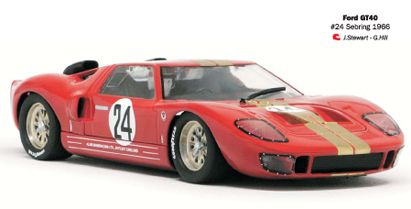
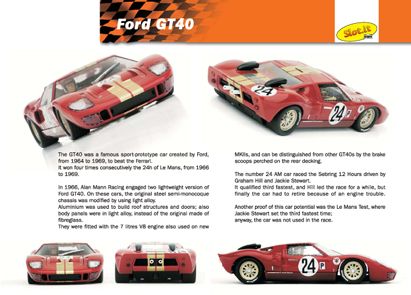
CA18a, Ford GT40 - #24 Sebring 1966
Drivers: G.Hill, J.Stewart

The GT40 was a famous sport-prototype car created by Ford, from 1964 to 1969, to beat the Ferrari. It won four times consecutively the 24h of Le Mans, from 1966 to 1969.

In 1966, Alan Mann Racing engaged two lightweight version of Ford GT40. On these cars, the original steel semi-monocoque chassis was modified by using light alloy. Aluminium was used to build roof structures and doors; also body panels were in light alloy, instead of the original made of fibreglass. They were fitted with the 7 litres V8 engine also used on new MKIIs, and can be distinguished from other GT40s by the brake scoops perched on the rear decking.

The number 24 AM car raced the Sebring 12 Hours driven by Graham Hill and Jackie Stewart. It qualified third fastest, and Hill led the race for a while, but finally the car had to retire because of an engine trouble.

Another proof of this car potential was the Le Mans Test, where Jackie Stewart set the third fastest time; anyway, the car was not used in the race

New Slot It GT40

From Slot It:

CA18a, Ford GT40 - #24 Sebring 1966
Drivers: G.Hill, J.Stewart

The GT40 was a famous sport-prototype car created by Ford, from 1964 to 1969, to beat the Ferrari. It won four times consecutively the 24h of Le Mans, from 1966 to 1969.

In 1966, Alan Mann Racing engaged two lightweight version of Ford GT40. On these cars, the original steel semi-monocoque chassis was modified by using light alloy. Aluminium was used to build roof structures and doors; also body panels were in light alloy, instead of the original made of fibreglass. They were fitted with the 7 litres V8 engine also used on new MKIIs, and can be distinguished from other GT40s by the brake scoops perched on the rear decking.

The number 24 AM car raced the Sebring 12 Hours driven by Graham Hill and Jackie Stewart. It qualified third fastest, and Hill led the race for a while, but finally the car had to retire because of an engine trouble.

Another proof of this car potential was the Le Mans Test, where Jackie Stewart set the third fastest time; anyway, the car was not used in the race