Get Paid To Promote, Get Paid To Popup, Get Paid Display Banner -->
Showing posts with label Robert Livingston. Show all posts

Friday, May 11, 2007

Slot.It McLaren - review


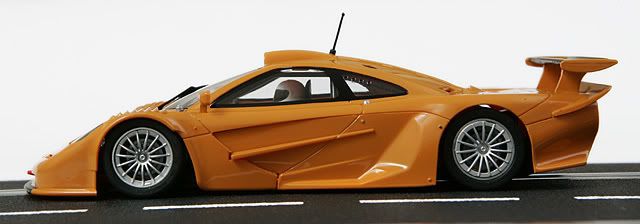
The release of a new car by Slot.It always attracts attention. The BMW McLaren F1 GTR seems to have attracted more than usual, due to its good looks and better-than-ever performance.

The car weighs 74 grams in stock form with the magnet. Without the magnet the car weighs 73 grams ...not much difference.

As noted in other reviews the front wheels can rub on the inside of the fenders, and maybe the headlight buckets. This was not a problem on our test car. However, there are small stubs of plastic on the inside surface of the hubs where they ride against the uprights. These little bumps cause the front wheels to wobble severely. Fortunately it's a simple fix to cut them off with a knife, and makes a huge improvement.

The wheels inserts don't fit well. Either the inserts are on the very edge of the wheel and not pushed back inside the wheel as they should be, or they're pushed inside the wheel at an angle. And one of the inserts has cracks on 3 of the spokes. The look of the inserts is nice, just the assembly seems poor.


As your eye runs along the angular lines of the body you see there are small details on nearly every surface of this car. The detail on the tail is particularly interesting, crisp, and precise.


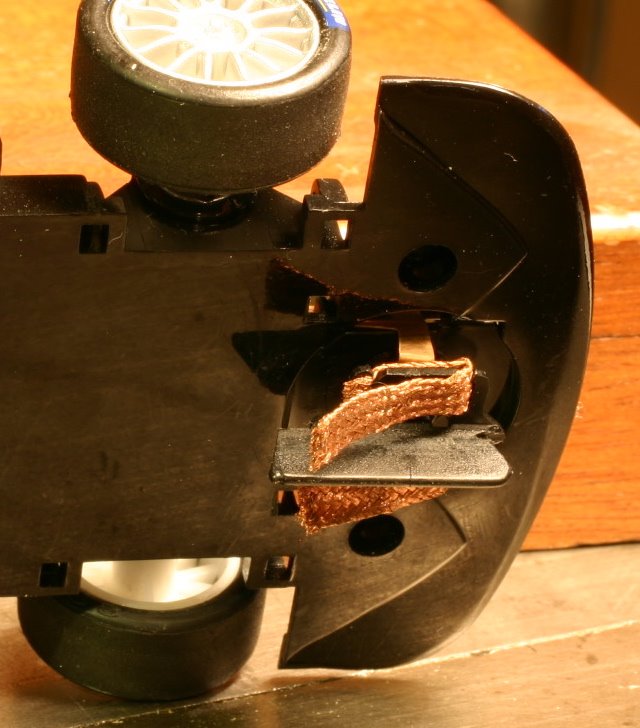
The wires run along the usual channels and under the front axle. The uprights for the front axle are quite thin.

The guide lead of the McLaren measures 100mm, which is the distance between the guide pivot point and the rear axle. With the car resting on a 1/4" rod to test the center point of the balance of the car, the balance point is about 65mm behind the pivot of the guide. In comparison, the Nissan's guide lead is 100mm and the balance point is about 66mm behind the pivot of the guide.

The gears mesh smoothly, with a 9-tooth pinion and a 26-tooth crown. The offset gear arrangement drops the motor shaft 1 mm below the axle centerline, which seems to increase cornering speed and stability.

Testing begins ...on the 61' East New York Raceway wood track. Voltage was set to 13.6v and we used a Prof. Motor 2055 controller.

In stock form (with magnet out), with stock tires and the pod tight, the first laps click off and we get a best time of 5.244 seconds. That is very, very fast for the stock tires still being on the car. The car feels slippery, but feels much better than most cars with stock tires. It handles nicely and has good balance.

Next, the body screws are loosened one turn on the rear and half turn on the front, still with tight pod screws. The car is much faster, easier, and times dropped to 5.156, with consistent 5.2's.

Still with the stock tires, the front pod screws are loosened only half a turn. The car feels not much different. Times stayed about the same. Next, the pod screws are loosened on front and rear a full turn. The pod now feels very loose. Times again dropped to 5.147. But the motor felt like it started to weaken. We stopped and lifted the rear of the car up a bit, gave it some throttle, and saw a red flash illuminate the body from inside! The motor continued to function. Off we went again. Times dropped to 5.101...guess the motor still works, eh?

Next we changed the tires to the S2's which are supplied with the car. Pod and body are still loose. A big increase in grip, and on the first lap the time dropped below 5 seconds, and on nearly every lap, for a few laps, the car rang the "faster bell" on the timer. The car doesn't seem to have any handling vices and never comes out of the slot at the front. Best time dropped to 4.765, and was solidly below 5 seconds on every lap.

Next, the tires are changed to SuperTires silicone tires (#1408) with the shoulders rounded by sanding. Times again dropped to 4.604 at best, with solidly lower times under 4.7 seconds. Down the straights the car feels very fast, much faster than with S2's.

In comparison, the Nissan 390 recently tested with SuperTires, and similar screw back-offs, did a best lap time of 4.723. Despite near identical mechanical specs, the driveability of the Nissan isn't as good as the new orange McLaren. The advantage appears to be the motor pod in the McLaren, which allows more movement of the pod out-of-the-box, as long as those pod screws are backed off.

Several orange end bell motors have been tested by Slot Car News, and the average rpm is about 23k at 12 volts, although the factory spec is only 21.5k/12v.

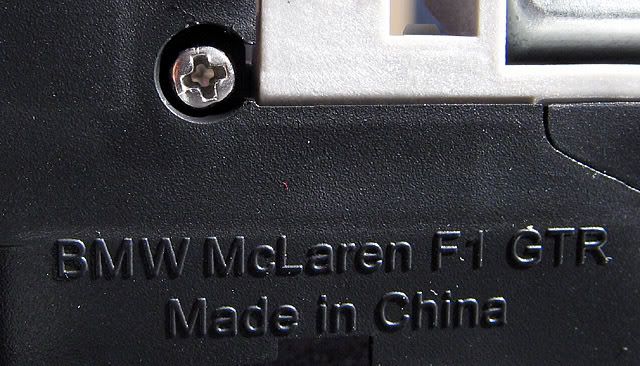
Of note are the large holes for the motor pod screws, which allow plenty of pod motion when the screws are backed off. The amount of pod motion is larger than seen on any previous, unmodified Slot.It car, and it does seem to help this car go fast. This small innovation is a huge improvement that will hopefully be carried on with every other new Slot It car.

The lap time with this car rival those achieved in the recent Slot.It Shoot Out held at this track, in which 20 modified Slot.It cars were raced, each carefully tuned by racers across the US and Canada. Out of the box, the Slot.It McLaren is a sure contender. A very fast car!

Thanks to Fantasy World Hobbies for the car for review.

Written by Dave Kennedy and Robert Livingston of Slot Car News.

Monday, March 5, 2007

Adjustable Front Axle Mount Kit


Slot Car Corner has released adjustable front axle mounts, which can be applied to a variety of existing car chassis. The adjustable blocks are sold in pairs, with four M2 set screws for precise up-and-down location of the front axle. This adjuster idea was first seen by this writer on the MRRC re-release of the famed Pro Slot Toyota GT1; now you can buy an adjustable mount that can be installed on any car you wish. Shown above is a Slot.It Sauber chassis, with one Slot.It axle height spacer or cap removed. The mounts are not yet installed.

The adjuster blocks will be installed using the original axle uprights as guides. 3/32" holes have been drilled through the chassis floor, to access the lower adjustment screws. The Slot.It chassis pan has been cut slightly, to receive the base of the adjuster blocks. The blocks can be installed facing in, facing out, or upside-down, to fit the exact chassis you choose.

The blocks are glued to the chassis, and the axle is slid in place. Everything fits very well.

The four set screws are run into the pre-tapped holes, and the axle is adjusted for height and vertical play. Adjustment is very easy, can be altered for different tracks, and can compensate for a slightly warped chassis, or for different guides or braids. The original axle uprights are left in place.
Adjustable axle mounts are available here:
Slotcarcorner.com

Thursday, February 22, 2007

Jel Claws tires

Jel Claws are soft tires which provide a wide variety of shapes and sizes for many cars. The tires are nicely molded, very true, and grip well on many surfaces. We have found they stick better and better the more you run them, as the tires seem to soften as they heat up, due to sliding friction. For certain cars, they may be superior to other brands. Experimentation will show which tires work optimally on which cars.

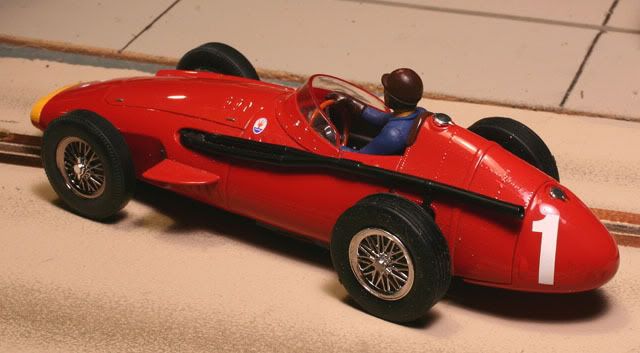
Jel Claws for "Aston Martin DBR1" are a good fit on Scalextric Classic F1 wheels, providing the correct size, and better traction than the original tires. These Jel Claws are a valuable addition to the range of tire options for vintage slot car racers.

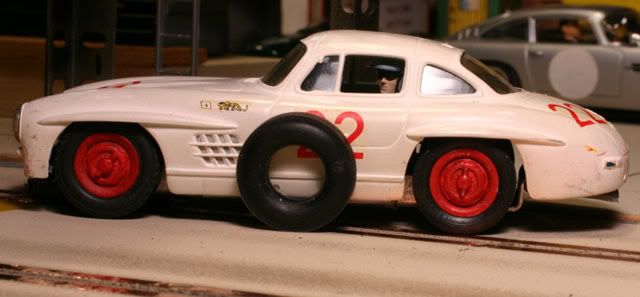
Jel Claws for "Early Revell" scale a huge 31" in diameter, which explains the perplexed look on face of the vintage Revell driver. Actual Revell tires are on the front, and Ortmann repro Monogram on the rear; these are the correct sizes for this car. These Jel Claws fit center-rib wheels, not found on early Revell slot cars, which used a drop-center rim.

Jel Claws "Ninco Classics" (on the right), softer than Ninco tires (on the left), and a slightly lower side wall. A great fit on the Ninco Classics rim.


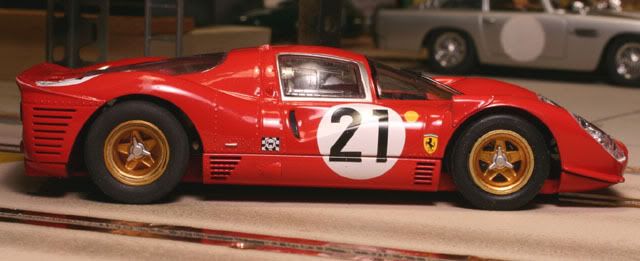
A rebuilt Scalextric Ferrari 330 P4 with scale sized Slot.It 15x8mm wheels on the rear, MMK on the front. Jel Claws tires for "Fly GT40 and Ferrari 365" fit perfectly, just a little tighter than the MRRC Chaparral tires shown in the picture below. Note the realistic curve to the sidewall. On the front, Jel Claws for Ninco Classics on the MMK narrow rims. Again, note the rounded sidewall.

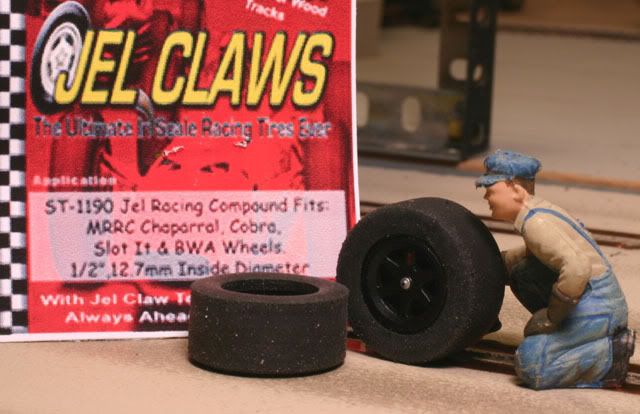
Jel Claws for "MRRC Chaparral, Cobra, Slot.It & BWA Wheels" do indeed fit Slot.It 15x8mm rims, a standard size for late 1960's through current-era race cars. Here a tire mechanic smiles on the good fit of these Jel Claws mounted on a Slot.It Sauber Mercedes rim.

Jel Claws tires can be sanded for perfect trueness and optimal profile, with light pressure and a medium grit paper.

Jel Claws are currently available from the e-bay store, at
this link.

Tuesday, February 20, 2007

Spirit S3X Motor


Here is what the Spirit website says about the new S3X long can motor which is in their newest cars:

"REF.00104 MOTOR SPIRIT S 3X Faster. Better Braking.
Stronger magnet effect
Specifications: 24.000RPM. / 12v
13,10 g.-cm magnetic force"

Ok, what does this mean? I assume the 13,10 "g.-cm" is an error, and they meant to say the motor produces 13.1 grams of magnetic downforce when placed at Spirit chassis height over Scalextric or other rails. This does not appear to be a torque rating, which would be in units of g-cm (a European decimal point is a comma, and a comma is a decimal point, in English). Several tests of other maker's long can motors with a Magnet Marshal show downforce readings of about 13 grams.

So that leaves us with the claim of 24k at 12 volts for the RPM rating.

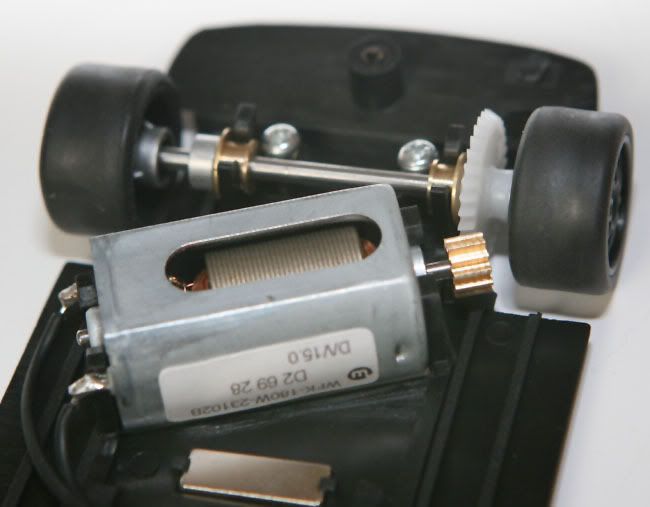
Slot Car News tested two sample S3X motors; one had the colorful wrapper proclaiming "S3X", while the other is in the photo above; plain metal finish with a white label, reading "FK-180" and "D/V 15.0", among other things. My hunch was the motor was rated 24k at 15 volts, not 12v as claimed.

Under the light of the tachometer, both motors spun up at 12 volts, no load, to nearly the same RPM: 19,725 RPM for one, and 19,814 RPM for the other. I adjusted the voltage upward to 15 for the faster motor, and measured 26,163 RPM.

By extrapolating the numbers, 19.8k RPM (15v/12v)=24.8k RPM estimated at 15 volts; right on the claimed rating for RPM, but at 15 volts. This agrees with both the label on the motor and approximate performance of the motor.

Therefore, the Spirit S3X is correctly represented as a 24k (up to 26k) motor at 15 volts, and correctly rated at some 19.8k at 12 volts. The torque is unknown. The label on the motor is correct; the info on the Spirit website is incorrect.

Saturday, August 5, 2006

Fly Ferrari 250 GTO


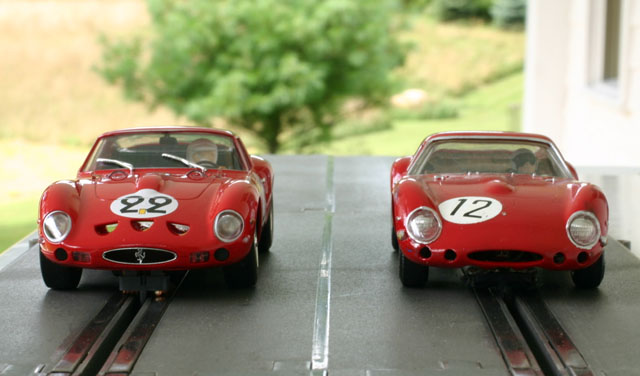
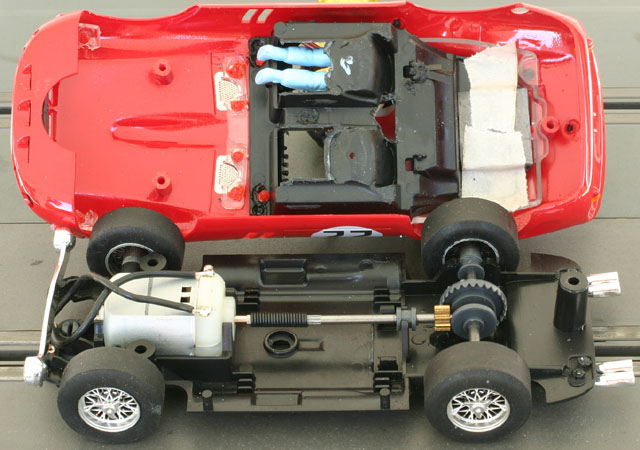
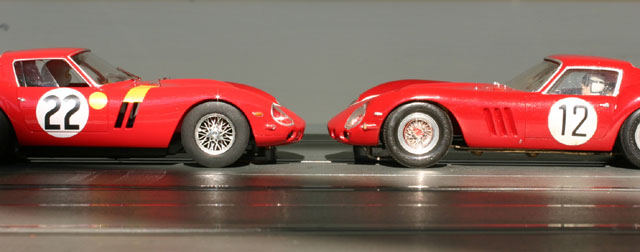
The new Fly Ferrari 250 GTO is one of their best, with fine detail, smooth finish, and great lines. There are delicate grilles beneath the transparent hood scoops, true to the actual cars. Hood latches are photo etched. Yellow discs were placed on the doors of this car at Le Mans, 1962, to alert rescue crews to the aluminum bodywork.


The Fly GTO compares well to the old standard Revell GTO, grandfather to the Pink Kar version. Fly model is better detailed, shows better curves, but has minor errors.


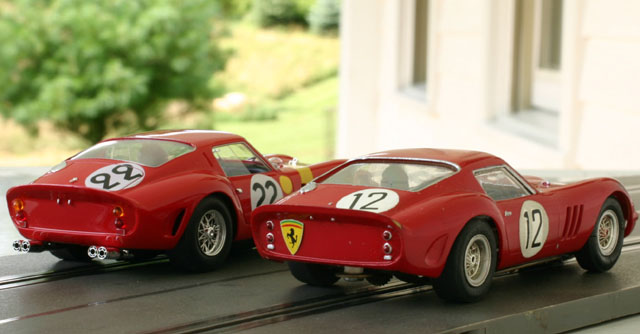
From the rear, the Fly car shows more curvaceous lines, in keeping with the timeless Ferrari design. Old Revell tail lights look better when painted, though. Fly tail lights resemble LEDs poking through the body.


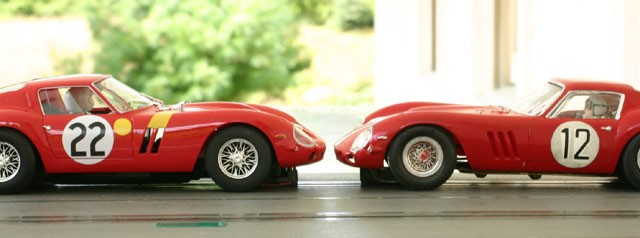
From the side, Fly scores again with full body lines and deeper side panels, but nose-high attitude of Fly is evident.


To drop the nose of the body, nearly 1/16" is trimmed from the two front (red plastic) body posts, and the same amount is removed from the headlight crossbar mounts (black plastic). Without lowering the headlight crossbar, the nose cannot drop. A clearance hole for the rear drive shaft bearing is cut between the seats, and the floor of the interior pan is cut away. The underside of the seats are filed to allow the body and interior to settle down onto the chassis. A slab of lead is taped under the rear deck to help the 70 gram car hook up a little better on the wood track. The guide is shimmed .030" to bring it deeper into the slot. These changes make the car driveable without its magnet.


With body lowered, the Fly car compares favorably to the older car. Now the front wheels are where they belong in the arches.


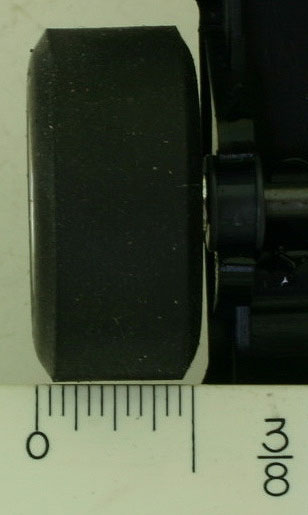
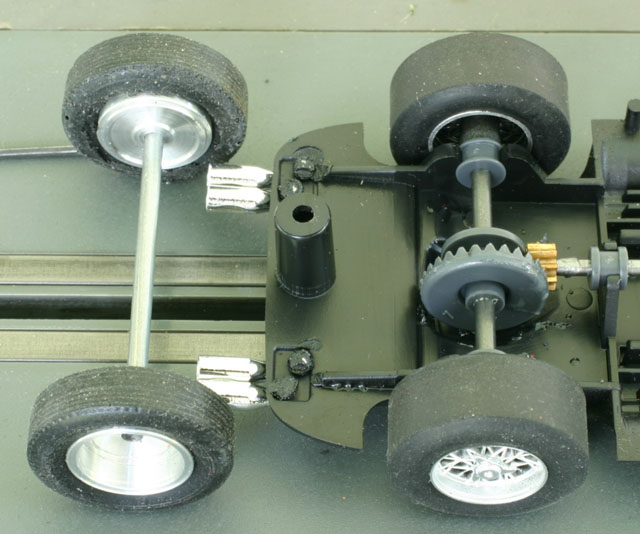
Rear tires measure a full 12" wide. The actual '62 GTO's had tires no more than 9 inches wide (7.00x15 size). Even the front tires are too wide for the rear. Although this error is not apparent from the side, it is anachronistic, and just plain wrong for the car. These fat tires belong on a 1967 or later car; the markings on this Ferrari are of an actual 1962 Le Mans contestant.


Replacement wheels by BWA, custom turned with a dropped center to take Ortmann repro Monogram rear tires (correct scale size) are lined up for eventual use on the Fly car. And I should point out that the plastic Fly axle bearings are a good fit on the axle, with almost no slop.


Another Revell GTO, with rocker panels extended slightly downward, and reworked side vents fore and aft, shows off its BWA wheels, Ortmann tires, and BWA inserts. These are a better representation of the actual GTO wheels and tires than the Fly wheels and tires.

No model is perfect, but the Fly Ferrari GTO is a fine model, and can be easily corrected in minor ways to be even better.

Sunday, June 18, 2006

SCX Aston Martin DBR9

SCX Aston Martin DBR9, reviewed and tuned by Robert Livingston


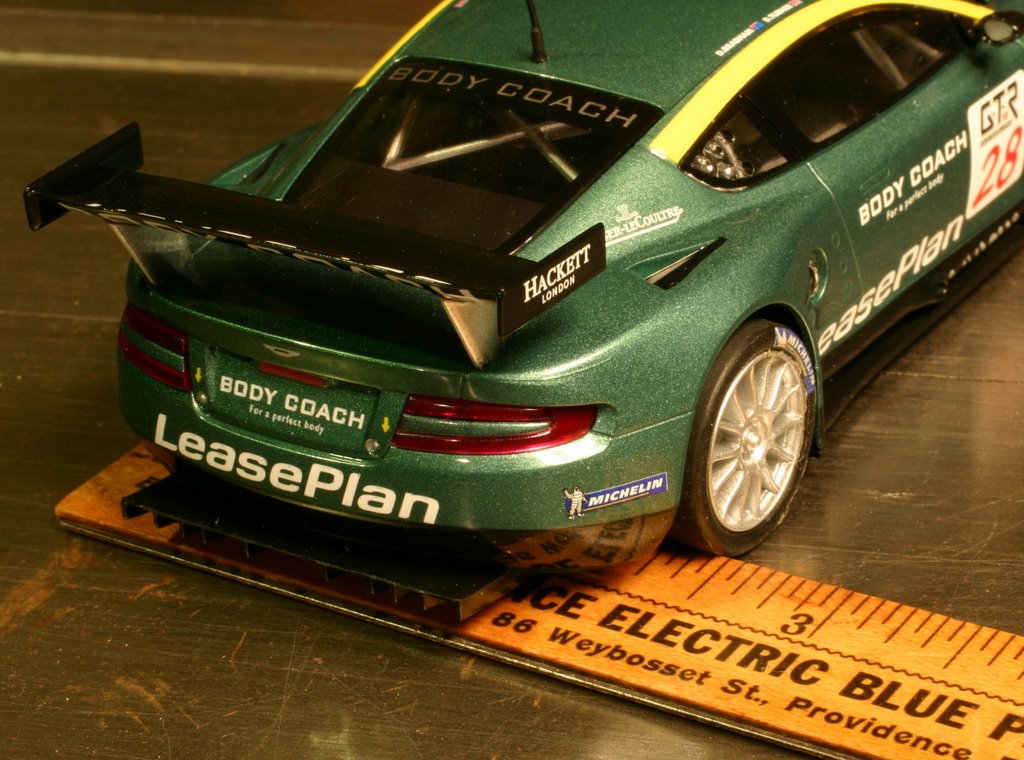
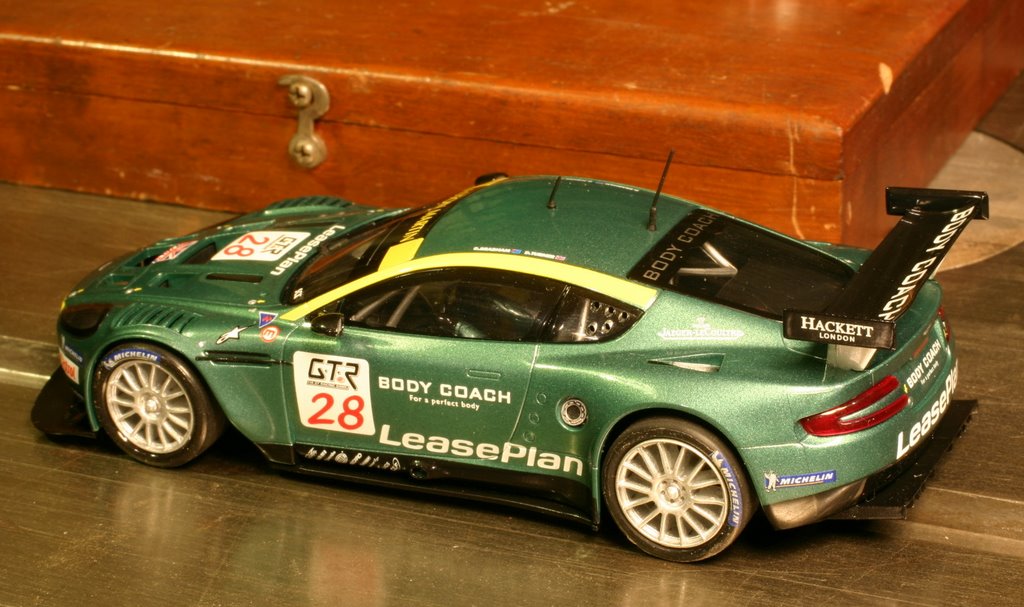
Nice mouth on this car. A classic. But how does it go, and what's inside?


The car is nearly 2.5" wide over the tires, and slightly less over the widest part of the body. Yes, the tires do hang out beyond the fenders.


A great looking replica. This model captures the spirit of the Aston Martin DBR9. Weight is 90 grams.


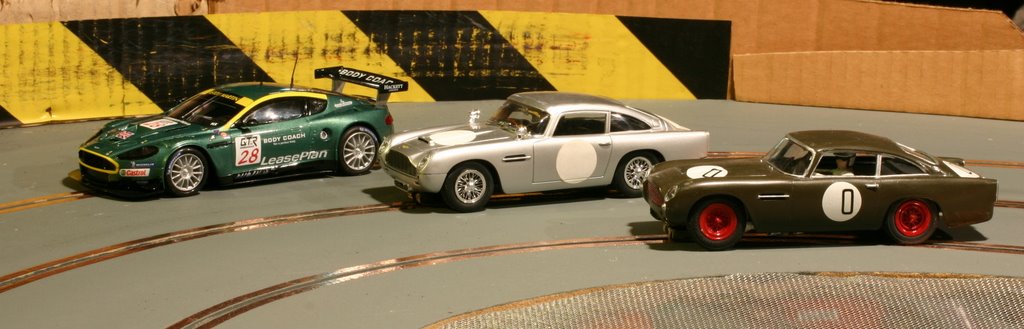
On the wood track, at 13.6 volts, the SCX DBR9 rivals the lap times of a stock Carrera DB5, and a parts-built Revell DB5, with vintage RP-77 motor. 6.5 seconds for a 61 foot lap, or 9.4 feet per second. Must be the tires! The car is sliding! I pulled the motor, shown below.


Motor is a new model, an RX-42. A quick test on the tach, and we see 15,400 RPM at 12 volts. Out with it! In goes an RX-62C, which has turned 20,100 on test at 12v. It fits perfectly (almost perfectly; I had to shorten the shaft and press the pinion closer to the motor).


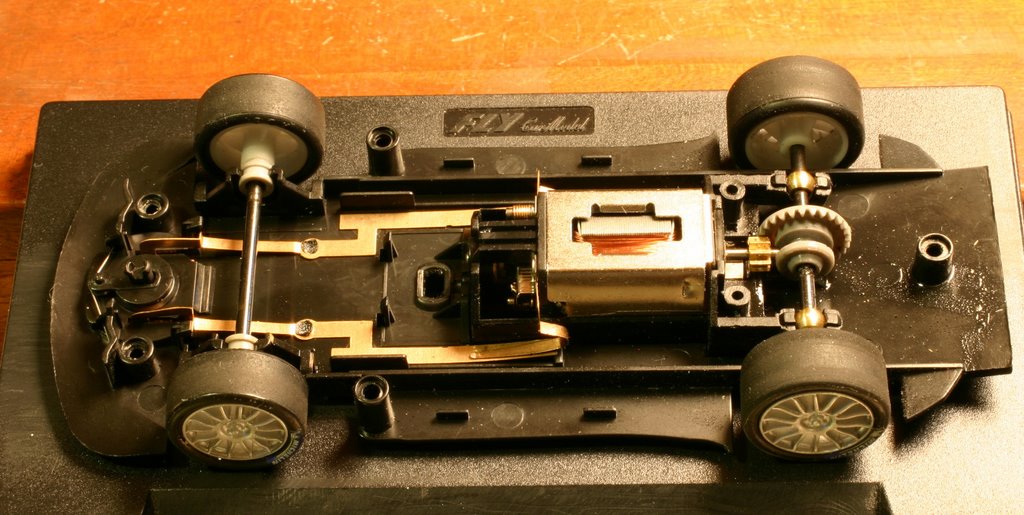
Above is shown the internal layout. Nice SCX rocking motor pod, spherical brass bearings at rear, a true running plastic gear, and a light centering spring on the guide. I reassembled it with only three of the five body mount screws: two under the nose, tight; and one at the rear, backed off a full turn. The chassis has enough flex, and the rocking pod takes care of the rest.
With the faster motor, lap times improve minimally, but the car is not hooking up. It is controllable, and feels well balanced, but the cornering speed is not there. I install some Ortmann for Slot.It replacement slicks, and the car hooks up and takes off. Lap times fall into the range of the highly competitive GT cars raced in RAA '06, on this very track (East New York Raceway). Best lap time is 5.385 for a 61 foot lap, or 11.3 feet per second. Not a bad time for a car on a nonmagnetic wood track. The car can be pushed, rarely deslots, and retains that good balanced feeling. However, it does deslot at times, and I noted the front tires are a little wobbly. 6 grams of lead under the front axle keeps it in the slot, along with this little mod:


The braids are re-arranged so a single pigtail trails back from the front of the guide, and the nose and tail of the flag are trimmed with a reverse rake, which helps the guide stay in the slot when it bangs against the stops.


Nice tampos! The SCX Aston Martin DBR9 is a good one. It handles well, and with the right tires for the track, it handles even better. The original motor is a little slow, but should be sufficient for short tracks with straights seven feet or less. This is a fine car, with great potential for stock-based, magnet-free GT racing.